
How ChatGPT Ads Work, And Why Ecommerce Brands Should Care in 2026?
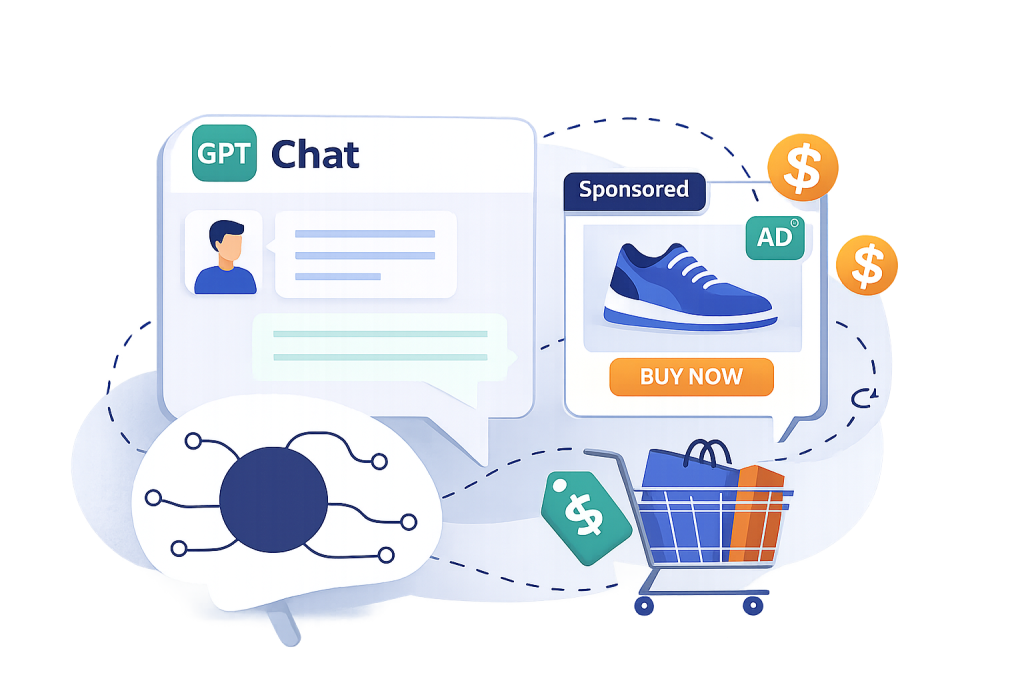
ChatGPT ads are sponsored placements that appear within the ChatGPT interface when a user’s query signals commercial or solution-oriented intent. Unlike traditional display ads or social placements, Chat GPT ads are shown alongside relevant AI responses, clearly labeled as sponsored content, without influencing the AI’s organic answer.
Early breakdowns of the format describe them as contextual “Sponsored Recommendations” that appear below AI responses in clearly marked sections. This format positions Chat GPT ads closer to high-intent search advertising than passive display media.
Users typically engage ChatGPT with direct, problem-focused queries such as ‘What’s the best laptop for video editing?’. That behavior signals research and purchase intent, making the environment inherently performance-oriented.
- Are ChatGPT Ads Available to All Ecommerce Stores?
- Why Should Ecommerce Brands Treat ChatGPT Ads Like High-Intent Search Ads?
- How Do ChatGPT Ads Fit Into an Ecommerce Media Mix?
- How Should Ecommerce Stores Prepare for Chat GPT Ads, Even If They Can’t Use Them Yet?
- Could Chat GPT Ads Change Ecommerce Advertising in 2026?
For ecommerce brands, this represents a new opportunity to surface products in moments of active decision-making rather than passive browsing.
What are ChatGPT ads?
Chat GPT ads are sponsored placements that appear within the ChatGPT interface when users submit commercially relevant queries. They are labeled as ads and do not influence the AI’s organic responses.
Are ChatGPT ads available worldwide?
No. As of 2026, Chat GPT ads are primarily available in the United States and limited to certain tiers. Broader rollout has not yet been fully confirmed.
What is the minimum spend for Chat GPT ads?
Industry reports indicate a minimum spend of approximately $200,000, with CPMs around $60, positioning the format as enterprise-focused for now.
How are ChatGPT ads different from Google search ads?
While both capture high intent, Chat GPT ads appear in conversational AI environments rather than search engine results pages. They are triggered by natural language queries rather than keyword bidding alone.
Should small ecommerce stores invest in ChatGPT ads?
At this stage, most small and mid-sized ecommerce brands should monitor the channel rather than invest heavily, due to high minimum spend requirements. Preparation through strong search optimisation and structured product data remains the more practical strategy.
Are ChatGPT Ads Available to All Ecommerce Stores?
No, and this is important.
As of early 2026, ChatGPT ads are currently:
- Available primarily in the United States
- Limited to specific ChatGPT tiers
- Restricted to brands willing to meet significant minimum spend thresholds
Industry reporting indicates early access requires approximately $200,000 in minimum spend, with CPMs reportedly around $60, positioning this as an enterprise-level pilot channel rather than an SMB-ready performance tool.
This means ChatGPT ads are currently best suited for large ecommerce brands, marketplaces, and advertisers with substantial media budgets.
However, the strategic implications extend far beyond early adopters.
Why Should Ecommerce Brands Treat ChatGPT Ads Like High-Intent Search Ads?
ChatGPT ads function similarly to search ads in one crucial way: they capture explicit intent.
When users type into ChatGPT, they are rarely scrolling aimlessly. They are asking specific questions, seeking recommendations, comparing solutions, or evaluating products. Marketing strategists analyzing the channel have noted that conversational advertising environments tend to capture intent signals similar to traditional search queries (see analysis from Single Grain).

This makes Chat GPT ads particularly powerful for:
- High-consideration products
- Category comparison queries
- Educational purchase journeys
- Products requiring explanation or context
In this sense, ChatGPT ads should not replace search advertising, they should be considered an extension of your search strategy into conversational AI environments.
Brands already investing heavily in ecommerce search optimisation understand how valuable high-intent traffic can be. ChatGPT ads expand that philosophy into a new interface.
How Do ChatGPT Ads Fit Into an Ecommerce Media Mix?
The modern ecommerce media mix typically consists of:
- Paid search & shopping campaigns
- Performance social advertising
- Retargeting & dynamic remarketing
- Organic SEO & content marketing
ChatGPT ads introduce a new high-intent touchpoint between awareness and transaction.
Some early overviews of the format describe it as bridging the gap between consultative content and performance ads, appearing in context when users actively seek recommendations .
For brands with sufficient budget, the channel can complement:
- Google Search Ads (capturing parallel conversational demand)
- Category-level shopping campaigns
- Educational content marketing efforts
The most resilient ecommerce strategies combine paid acquisition with strong organic foundations. Investing in AI-powered product discovery solutions ensures your product data and taxonomy are optimized not only for search engines but also for emerging AI-mediated environments.
In 2026, media diversification is not optional, it is defensive strategy.

How Should Ecommerce Stores Prepare for Chat GPT Ads, Even If They Can’t Use Them Yet?
Even if ChatGPT ads are not financially accessible today, preparation creates advantage.
Conversational advertising environments reward:
- Clear product differentiation
- Structured product attributes
- Context-aware messaging
- Strong landing page alignment
Brands that strengthen their intelligent merchandising and personalization strategies will be better positioned to support high-intent AI traffic when broader rollout occurs.
Additionally, optimizing content around question-based search patterns improves both organic performance and readiness for conversational ad formats. Investing in strong search intelligence today reduces dependency on paid channels tomorrow.
ChatGPT ads are part of a broader AI-commerce shift, not an isolated experiment.
Could Chat GPT Ads Change Ecommerce Advertising in 2026?
Potentially, yes.
If conversational AI continues to grow as a product discovery layer, Chat GPT ads could become one of the most valuable high-intent placements in digital marketing. Much like early search advertising, the brands that experiment early and refine creative strategies quickly may secure long-term advantage.
However, Chat GPT ads are not a silver bullet. They are currently expensive, geographically limited, and evolving rapidly. Ecommerce brands should treat them as:
- A premium experimental channel
- A strategic complement to search
- A signal of where advertising infrastructure is heading
The long-term implication is clear: as AI platforms mediate more product research, ecommerce advertising will follow the user into conversational environments.
The question is not whether AI will influence media strategy.
The question is how early your brand adapts.

Soma is managing wide aspects of Prefixbox’s online presence – let it be social media, content or paid ads. He’s a passionate online marketer based in Budapest, Hungary, with a keen interest in cutting-edge technologies and innovative solutions.