
Everything about Shopify Agentic Storefront: How Can ChatGPT Sell Your Products?
Shopify Agentic Storefront allow merchants to sell products directly through AI platforms like ChatGPT, Gemini, Copilot, and Perplexity. This way, shoppers can discover, compare, and purchase products inside AI conversations, without visiting a traditional storefront.
Agentic Storefronts represent Shopify’s entry into what it calls AI commerce at scale. Instead of forcing shoppers to navigate websites, filters, and category pages, Shopify enables AI agents to act as storefronts themselves. These agents can browse catalogs, answer questions, recommend products, and complete checkout using Shopify’s existing infrastructure.
The shift reflects a broader trend: conversational AI is quickly becoming a primary interface for discovery, not just a support tool.

How Do Shopify Agentic Storefronts Work?
Agentic Storefronts work by exposing a merchant’s product catalog to participating AI platforms through Shopify. Once enabled in the Shopify admin, product data such as titles, pricing, variants, and availability can be accessed by AI agents that are integrated with Shopify.
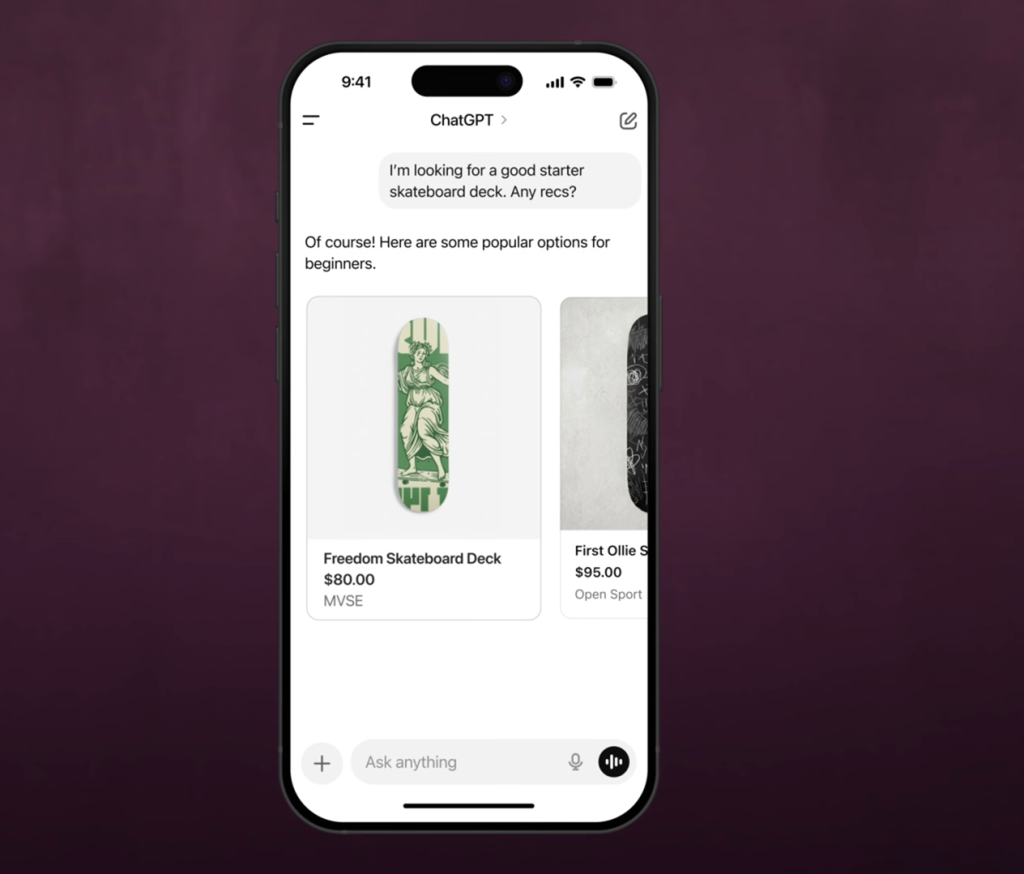
When a shopper asks an AI assistant a shopping-related question, such as “What’s a good espresso machine under $500?”, the AI can pull relevant Shopify products, present options, answer follow-up questions, and complete the purchase through Shopify checkout. Orders, payments, taxes, and fulfillment all remain within the Shopify ecosystem.
This allows AI platforms to become fully functional sales channels, while Shopify remains the commerce backbone.
Why Did Shopify Build Agentic Storefront?
Shopify built Agentic Storefronts because consumer behavior is shifting rapidly toward AI-driven discovery. More shoppers are starting their journeys by asking questions, not typing keywords into search engines or navigating menus.
Shopify Agentic Storefront ensures Shopify merchants remain discoverable wherever AI-based shopping happens.
What Is Agentic Commerce?
Agentic commerce is a model where AI agents act on behalf of shoppers to research products, compare options, and complete purchases autonomously or semi-autonomously.
Instead of presenting a list of links, agentic systems actively reason about user intent and take action. Shopify Agentic Storefront is one of the first large-scale implementations of this concept in ecommerce.
How Is This Different From a Traditional Online Store?
Traditional ecommerce assumes shoppers will come to a merchant’s website, browse categories, apply filters, and search manually. Agentic commerce flips this model.
With Agentic Storefronts, the customer journey often starts and ends in a conversation. The AI agent handles discovery, narrowing options, answering questions, and executing checkout. The store no longer has to be the starting point, it becomes the fulfillment engine behind the scenes.
This doesn’t eliminate websites, but it significantly changes their role in the overall journey.
What Is the Agentic Commerce Protocol (ACP)?
The Agentic Commerce Protocol (ACP) is a standardized way for AI platforms to interact with commerce systems like Shopify. It allows AI assistants to browse products, check availability, build carts, and initiate checkout, without custom integrations for each merchant.
In simple terms, ACP turns AI platforms into marketplaces, enabling them to transact directly with stores. This is what allows ChatGPT or Gemini to sell real products rather than just recommend them.
What Is MCP (Model Context Protocol), and How Is It Different?
Answer:
MCP, or Model Context Protocol, is a framework that helps AI models access structured data and tools safely and consistently. It’s commonly used to build custom AI agents that can reason over APIs, product data, and internal systems.
The key difference is scope and intent:
- ACP is about enabling external AI platforms to sell products as a new channel.
- MCP is about building controlled, customized AI experiences tied closely to a merchant’s own systems.
They are complementary technologies: ACP expands reach, MCP enables depth and customization.
How Will Agentic Storefronts Change Ecommerce Overall?
Agentic Storefronts signal a major shift in ecommerce: from website-centric shopping to conversation-centric shopping.
AI agents reduce friction by handling comparison, research, and decision-making in a single interface. For shoppers, this means faster, more confident purchases. For merchants, it means discovery happens earlier, in more places, and often outside the traditional storefront.
Over time, AI agents will become another permanent sales channel, alongside websites, apps, marketplaces, and physical stores.
Does This Mean Merchant Websites Are Less Important?
No,but their role evolves.
Websites remain essential for brand identity, trust, rich browsing, and post-purchase engagement. However, AI agents increasingly handle early-stage discovery and decision-making. This makes on-site experiences even more important once shoppers arrive. They expect clarity, speed, and intelligent guidance.
Where Do Third-Party AI Agents Fit In?
Shopify Agentic Storefront brings products into external AI platforms. Third-party AI agents like Prefixbox AI Agent focus on what happens inside the store.
Prefixbox AI Agent acts as an in-store conversational sales assistant. It helps shoppers ask natural language questions, find relevant products, compare options, understand compatibility and specifications, and move confidently toward checkout, without leaving the merchant’s site.
In this sense, Prefixbox AI Agent becomes another sales channel inside the store, complementing Shopify’s external agentic channels rather than competing with them.
Why Do Merchants Need Both External and In-Store AI Agents?
Because modern commerce happens across multiple touchpoints.
Agentic Storefronts capture demand in AI platforms where customers start their journey. In-store AI agents convert that demand once shoppers arrive on the site. Together, they create a continuous, AI-powered shopping experience, from discovery to conversion.
This dual approach ensures merchants don’t just reach customers, but also guide them effectively to purchase.
Final Takeaway
Shopify Agentic Storefront marks a fundamental shift: conversations are becoming storefronts. Merchants who combine external AI sales channels with in-store conversational agents will be best positioned to win in this new era, capturing discovery wherever it happens and converting intent wherever shoppers land.

Soma is managing wide aspects of Prefixbox’s online presence – let it be social media, content or paid ads. He’s a passionate online marketer based in Budapest, Hungary, with a keen interest in cutting-edge technologies and innovative solutions.