
Why Google’s Universal Commerce Protocol Will Redefine Ecommerce in 2026
Ecommerce has always evolved alongside interface shifts. First came the marketplace era. Then mobile. Then social commerce. Now, we are entering something fundamentally different: commerce mediated not by websites, but by AI agents.
Google’s newly introduced Universal Commerce Protocol (UCP) signals that this shift is no longer speculative. And with the recent rollout of UCP-powered checkout inside Google’s AI Mode, we are witnessing the early infrastructure of agentic commerce taking shape.
- What Is Google’s Universal Commerce Protocol?
- How Does UCP-Powered Checkout in Google’s AI Mode Change the Shopping Journey?
- Why Is This Shift Bigger Than Just a New Google Feature?
- What Is Agent Optimization, And Why Does It Matter Now?
- How Will AI Agents Change Product Discovery?
- What Happens to the Checkout Experience in an AI-Mediated Environment?
- How Could UCP Affect Ecommerce Media and Advertising Strategies?
- How Should Ecommerce Brands Prepare for Agentic Commerce?
- Will Google’s Universal Commerce Protocol Redefine Ecommerce in 2026?
In practical terms, this means that users can now discover, evaluate, and in some cases complete purchases directly inside Google’s AI interface, without navigating through traditional ecommerce flows. For select retailers, AI Mode has already begun enabling checkout experiences powered by UCP, compressing what used to be a multi-step journey into a single conversational interface.
This is not just a feature update. It is a structural change in how digital commerce operates.
What Is Google’s Universal Commerce Protocol?
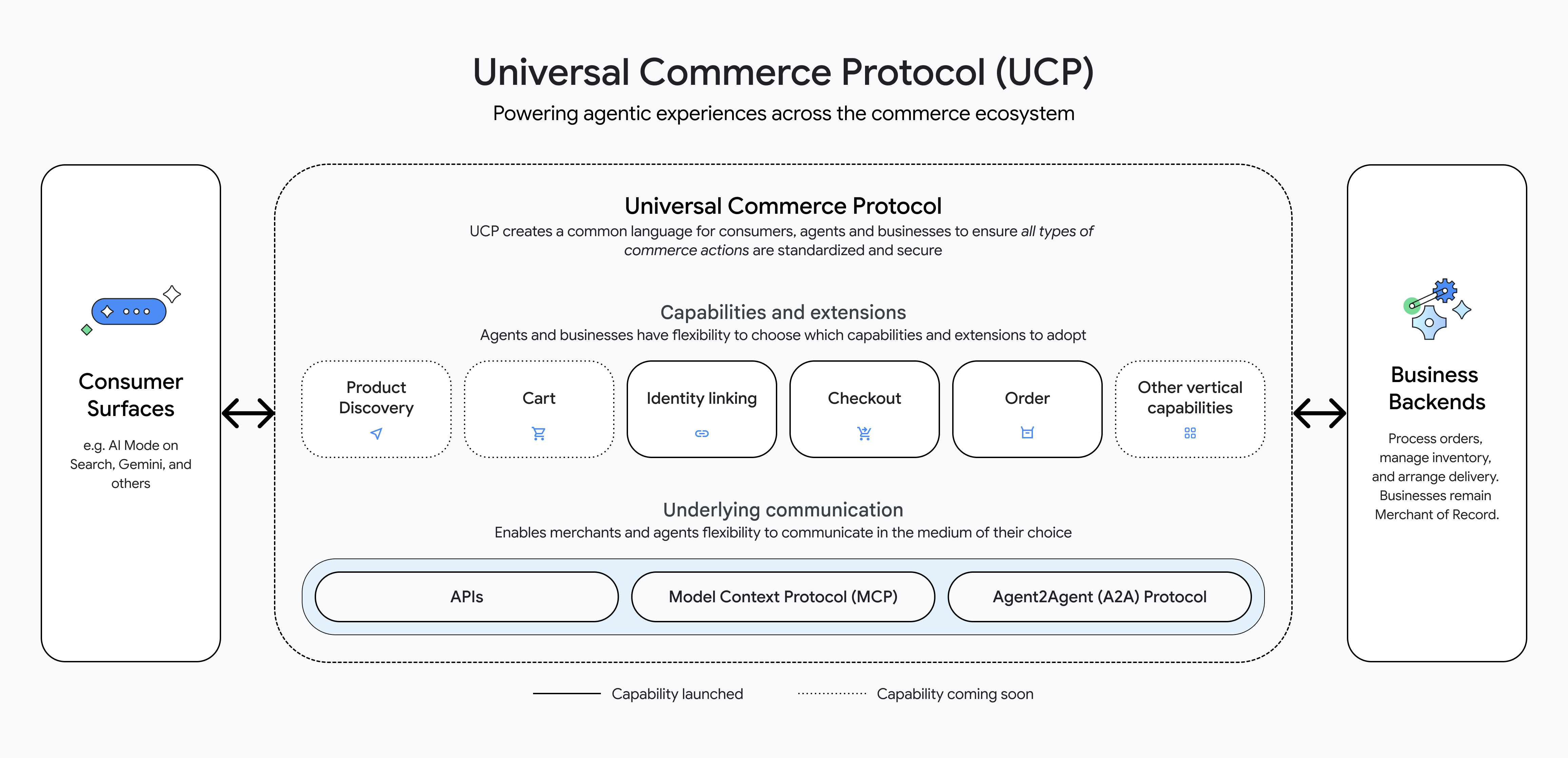
Google’s Universal Commerce Protocol (UCP) is a standardized framework that allows AI systems to interact directly with ecommerce platforms in a structured, machine-readable way. Rather than relying on scraping or fragmented APIs, AI agents can retrieve product information, check availability, apply merchant policies, and initiate transactions through a unified protocol layer.
Google introduced UCP as part of its broader push toward agentic commerce infrastructure, and recent reporting confirms that it is already powering early transactional capabilities inside AI Mode (as covered by Search Engine Roundtable).
Why Does UCP Matter For Ecommerce Stores?
UCP matters because it shifts ecommerce from being optimized purely for human browsing to being optimized for AI-mediated interaction. In 2026 and beyond, the primary interface between intent and transaction may increasingly be an AI agent, and UCP is the infrastructure enabling that shift.
How Does UCP-Powered Checkout in Google’s AI Mode Change the Shopping Journey?
With the rollout of UCP-powered checkout inside Google’s AI Mode, the traditional ecommerce funnel is being compressed. Instead of moving from search results to a merchant site, browsing products, adding to cart, and completing checkout, users can now finalize purchases directly inside Google’s AI interface for select retailers.
According to Google’s official documentation on UCP, the protocol enables secure communication between AI systems and merchant infrastructure while keeping the merchant as the seller of record. This preserves transaction ownership while removing friction from the user experience.
The result is a shortened funnel:
Discovery → Evaluation → Checkout, all inside a conversational AI environment.
For consumers, this reduces cognitive load. For merchants, it shifts competitive dynamics from website UX toward structured data quality and AI visibility.
Why Is This Shift Bigger Than Just a New Google Feature?
UCP represents a structural evolution in how commerce systems connect to demand. For years, ecommerce leaders focused on optimizing user experience, checkout design, and page performance. Now, optimization must also account for machine consumption.
When AI agents evaluate products across merchants, structured product data, policy transparency, and pricing consistency become critical. Brands that already invest in strong AI-powered product discovery solutions are better positioned for this transition because their product data is already enriched, structured, and machine-readable.
This is not about replacing websites. It is about extending commerce infrastructure into AI environments.
What Is Agent Optimization, And Why Does It Matter Now?
Agent optimization means preparing your ecommerce infrastructure so AI systems can accurately interpret, compare, and act on your product data. Traditional SEO ensures visibility in search engines. Agent optimization ensures visibility in AI-mediated recommendations and automated purchase flows.
This depends heavily on clean taxonomy, enriched attributes, and intelligent ranking logic. Merchants that prioritize ecommerce search optimization already build much of this foundation. Advanced search systems rely on structured metadata, relevance signals, and real-time inventory feeds, the same elements AI agents need to evaluate products effectively.
In this emerging landscape, search quality and AI readiness are deeply interconnected.
How Will AI Agents Change Product Discovery?
AI agents are reshaping product discovery by acting as evaluators rather than just assistants. Instead of manually comparing multiple tabs, users may increasingly rely on AI systems to assess price, fulfillment speed, return policies, reviews, and contextual preferences in real time.
This means product metadata is no longer just a backend detail, it becomes a visibility lever. If your attributes are incomplete or inconsistently structured, AI agents may misinterpret or deprioritize your offering.
Brands that implement strong intelligent merchandising and personalization strategies can better influence how their products surface in AI-driven comparisons. Personalization logic upstream becomes decisive when checkout is compressed downstream.
What Happens to the Checkout Experience in an AI-Mediated Environment?
Historically, checkout was a conversion battlefield. Merchants refined UX elements, added trust signals, introduced cross-sells, and optimized flows to reduce abandonment. But when checkout occurs inside AI environments via UCP, much of that influence moves earlier in the journey.
In an AI Mode transaction, the recommendation phase becomes more critical than the cart page. Intelligent ranking, contextual relevance, and structured clarity determine whether an agent selects your product before checkout is even initiated.
This does not eliminate the importance of onsite experience, it changes where competitive leverage lives.
How Could UCP Affect Ecommerce Media and Advertising Strategies?
If AI systems increasingly mediate product discovery, ecommerce brands must reconsider their media mix. The integration of sponsored placements, algorithmic prioritization, and AI-curated recommendations could reshape how performance marketing operates.
While Google has not fully detailed how advertising will evolve inside AI Mode, it is reasonable to expect experimentation in this area. Brands should monitor shifts in traffic patterns and attribution as AI-driven interfaces expand.
The ecommerce media mix of 2026 may look materially different from today’s search-centric allocation models.
How Should Ecommerce Brands Prepare for Agentic Commerce?
Preparation begins with infrastructure. Merchants should evaluate product data completeness, ensure structured attributes are robust, and confirm that pricing and inventory feeds are reliable. AI readiness is not achieved through surface-level AI features, it requires strengthening the structural integrity of your commerce architecture.
Brands that invest early in search intelligence, merchandising logic, and structured data systems will be significantly better positioned when AI Mode and similar environments scale.
As agentic commerce matures, the dividing line will not be who adopted AI first, but who built infrastructure that AI can interpret and act upon.
Will Google’s Universal Commerce Protocol Redefine Ecommerce in 2026?
Yes, because it changes the interface between consumer intent and transaction.
Websites will remain important. But they will increasingly operate within a broader ecosystem where AI systems interpret needs, compare options, and sometimes execute purchases autonomously.
Google’s Universal Commerce Protocol is not just another API. It is early infrastructure for agentic commerce at scale.
The brands that recognize this shift early, and align their data, discovery systems, and merchandising strategy accordingly, will have a measurable competitive advantage.
The question is no longer whether AI will reshape ecommerce.
The question is whether your infrastructure is ready for it.

Soma is managing wide aspects of Prefixbox’s online presence – let it be social media, content or paid ads. He’s a passionate online marketer based in Budapest, Hungary, with a keen interest in cutting-edge technologies and innovative solutions.