
[Webinar] Where Search Meets Design: CRO Strategies in Action on a Live Store
What’s stopping shoppers from converting on your store? More often than not, it comes down to two things: they either can’t find what they’re looking for, or they don’t trust you enough to buy it. In this webinar, Aaron from Prefixbox and Greg Flint, co-founder and CEO of 413 Digital, broke down how search and design each play a distinct role in CRO — and what happens when the two come together.

- Why Does Search Matter So Much for CRO?
- What Makes Ecommerce Search Genuinely Intelligent?
- How Does the Prefixbox AI Agent Take Search Further?
- What Role Does Design Play in CRO?
- What Are the Biggest CRO Mistakes Ecommerce Stores Make?
- How Do Search and Design Come Together in Practice?
- How Do Search and Design Come Together in Practice?
- What Are the Key CRO Takeaways?
Why Does Search Matter So Much for CRO?
Industry data shows that while only around 15% of visitors use site search, they generate up to 45% of total revenue, and Amazon’s conversion rate jumps from 2% to 12% when visitors use the search function, a sixfold increase. These are shoppers who already know what they want: they have purchase intent baked in before they even land on your site.
Aaron used a simple analogy: think of someone who’s hungry and decides they want a burger. They don’t browse the food court debating options they drive straight to their favorite burger place. That’s a search user. Compare that to someone strolling through a mall thinking “maybe pizza, maybe Chinese” that’s a window shopper. Search captures the first type.
The challenge is making sure that when those high-intent shoppers type something into your search bar, they actually find what they’re looking for. If they don’t, most of them won’t refine their query. Around 82% of shoppers say they avoid websites where they’ve experienced search difficulties in the past, they’ll simply assume you don’t have what they need and leave.
What Makes Ecommerce Search Genuinely Intelligent?
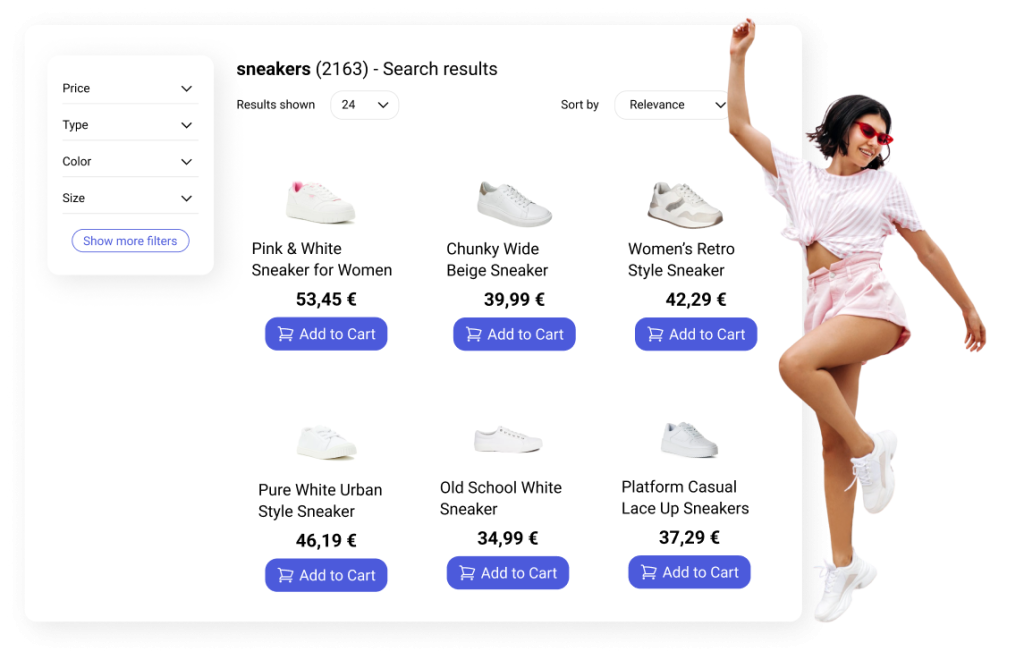
Keyword matching alone isn’t enough. A shopper searching for “waterproof hiking boots” shouldn’t be shown a waterproof jacket just because it shares two keywords. The search engine needs to understand the intent behind the query, not just match words to product names.
This gets more complex when you factor in that shoppers don’t always search the way your catalog is organized. They might type “beef and vegetables” when they want a burger. They might use a brand-specific term you don’t carry. Intelligent search bridges that gap.
Prefixbox approaches this through a combination of vector search, query understanding, and Re-Ranking AI. The re-ranking piece is particularly powerful: if 100 people search for “waterproof hiking boot” and 60 click on product X while only 5 click on product Z, that click data is used to rerank results for the next person who makes the same search. The algorithm learns what’s relevant from real shopper behavior similar to a store associate who, after seeing hundreds of customers, knows exactly what someone is looking for before they finish their sentence.
How Does the Prefixbox AI Agent Take Search Further?
Beyond the search bar, Prefixbox recently launched an AI Agent chat widget that lives on your store and acts as that all-knowing sales associate.
Where the search bar handles one-way queries, the AI Agent can have a full conversation. If a shopper types “I’m going maple tapping, what do I need?”, the agent doesn’t just return results it asks clarifying questions like “What do you already have?” and “How many gallons are you planning to make?” It narrows down the results through dialogue, getting closer to exactly what the shopper needs with each exchange.
As Greg put it: imagine having the knowledge of every sales associate who has ever worked in your store, combined and available to every shopper at once. That’s the level of intelligence the AI Agent brings to product discovery.
What Role Does Design Play in CRO?
Once a shopper finds a product they like, design takes over. Its job is to convert intent into confidence.
Greg made the point that good design is largely subconscious. Nobody notices consistent fonts and clean spacing but everyone notices when something feels off. A misaligned element, an inconsistent product card height, or a rating displayed too large next to a product name too small all create friction that shoppers can’t always articulate but absolutely feel.
He shared a telling example from his agency’s software work: clients kept saying a system felt “slow,” but every performance test passed. The real issue was a minor layout overlap on certain viewport sizes. Once fixed, the same clients said it felt “so much faster” even though nothing about the actual speed had changed. What changed was their confidence in it.
Design, in this framing, is not about adding visual flair. It’s about reducing cognitive load, creating consistency, and guiding shoppers toward a decision without overwhelming them. Baymard Institute’s research on eCommerce UX consistently shows that small friction points at the decision stage are among the top drivers of cart abandonment.
What Are the Biggest CRO Mistakes Ecommerce Stores Make?
- Too many CTAs. Aaron’s analogy: going to a gas station where the cashier asks five upsell questions in a row. You can’t tell them to stop, so you endure it but online, shoppers just close the window. Every unnecessary ask is a conversion risk.
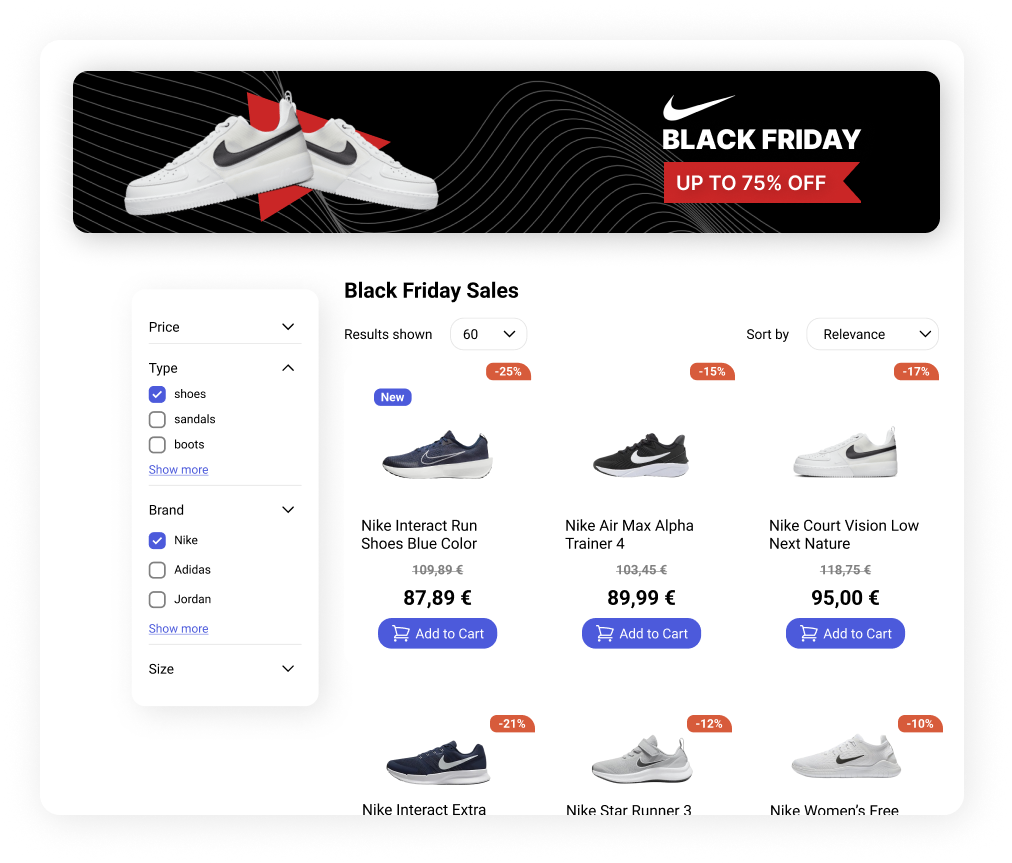
- Inconsistent product cards. Varying image heights, misaligned prices, different font sizes across cards these break the visual rhythm that lets shoppers quickly scan and decide. Our brains are wired for symmetry, and inconsistency erodes trust before a shopper has even read a product name.
- No trust signals near decisions. Ratings and reviews should live next to every add-to-cart button, not buried on a product page. Shoppers decide fast give them the social proof they need exactly where they need it.
- Desktop-first design. Mobile now accounts for over 70% of eCommerce traffic, and 57% of global eCommerce sales happen on mobile devices. Designing on a large monitor and checking mobile as an afterthought is one of the most common and costly mistakes in the industry.
How Do Search and Design Come Together in Practice?
Aaron and Greg used Cherry Republic a Michigan-based specialty food brand as a live example of what it looks like when both are done well.
From the design side: clear, prominent navigation, a trust-building banner offering free shipping over $99 (visible immediately on landing), and a consistent set of product cards that make scanning effortless. The brand communicates its values local farming, a quality guarantee, Michigan provenance before the shopper has even searched for anything. By the time they’re ready to browse, trust is already established.
From the search side: a query like “salty” returns results that are genuinely salty in nature not just products with “salt” in the name. Vector search understands the meaning behind a query. Product cards are consistent, reviews surface inline, and the experience translates cleanly to mobile.
As Aaron summarized: search answers what what products you have, what a shopper might want. Design answers why why this product, why this store, why now. When both are aligned, conversion feels effortless. It feels like the store already knows what you want.
How Do Search and Design Come Together in Practice?
Aaron and Greg used Cherry Republic, a Michigan-based specialty food brand, as a live example of what it looks like when both are done well.
From the design side: clear, prominent navigation, a trust-building banner offering free shipping over $99 (visible immediately on landing), and a consistent set of product cards that make scanning effortless. The brand communicates its values local farming, a quality guarantee, Michigan provenance before the shopper has even searched for anything. By the time they’re ready to browse, trust is already established.
From the search side: a query like “salty” returns results that are genuinely salty in naturel, not just products with “salt” in the name. Vector search understands the meaning behind a query, not just the literal keywords. Product cards are consistent, reviews surface inline, and the experience translates cleanly to mobile.
As Aaron summarized: search answers what what products you have, what a shopper might want. Design answers why why this product, why this store, why now. When both are aligned, conversion feels effortless. It feels like the store already knows what you want.
What Are the Key CRO Takeaways?
- Search users convert 6–7x higher than average visitors capturing their intent accurately is the single highest-leverage thing you can do for revenue.
- Intelligent search means understanding what shoppers mean, not just matching what they type. Vector search and behavioral re-ranking are what separate modern search from keyword matching.
- Design’s job is to reduce cognitive load and build trust not to impress, but to guide. Consistency, clear hierarchy, and mobile-first thinking are the foundations.
- Trust signals (reviews, guarantees, social proof) need to be placed near decisions, not hidden in footers or separate pages.
- CRO isn’t a checkout-page problem. It starts the moment a shopper lands on your site and search is a core part of that journey, not a separate concern.
Prefer to hear it in their own words? Watch the full recording below: